
Whiplash vs. Herniated Disc: How to Tell the Difference
Understanding Two of the Most Common Injuries After a Car Accident
Neck pain is one of the most common complaints following a motor vehicle accident, but not all neck injuries are the same. Two conditions that are frequently confused are whiplash and a herniated disc. While both can develop after the same collision and often produce similar symptoms, they affect different structures within the body and may require different approaches to diagnosis and treatment.
Understanding the difference between these injuries is important because an accurate diagnosis helps ensure patients receive the appropriate care and reduces the risk of long-term complications. At Plano Spine & Joint, Dr. Jason L. Ardis, D.C. specializes in evaluating and treating auto accident injuries using a comprehensive approach that focuses on identifying both obvious and hidden damage.
What Is Whiplash?
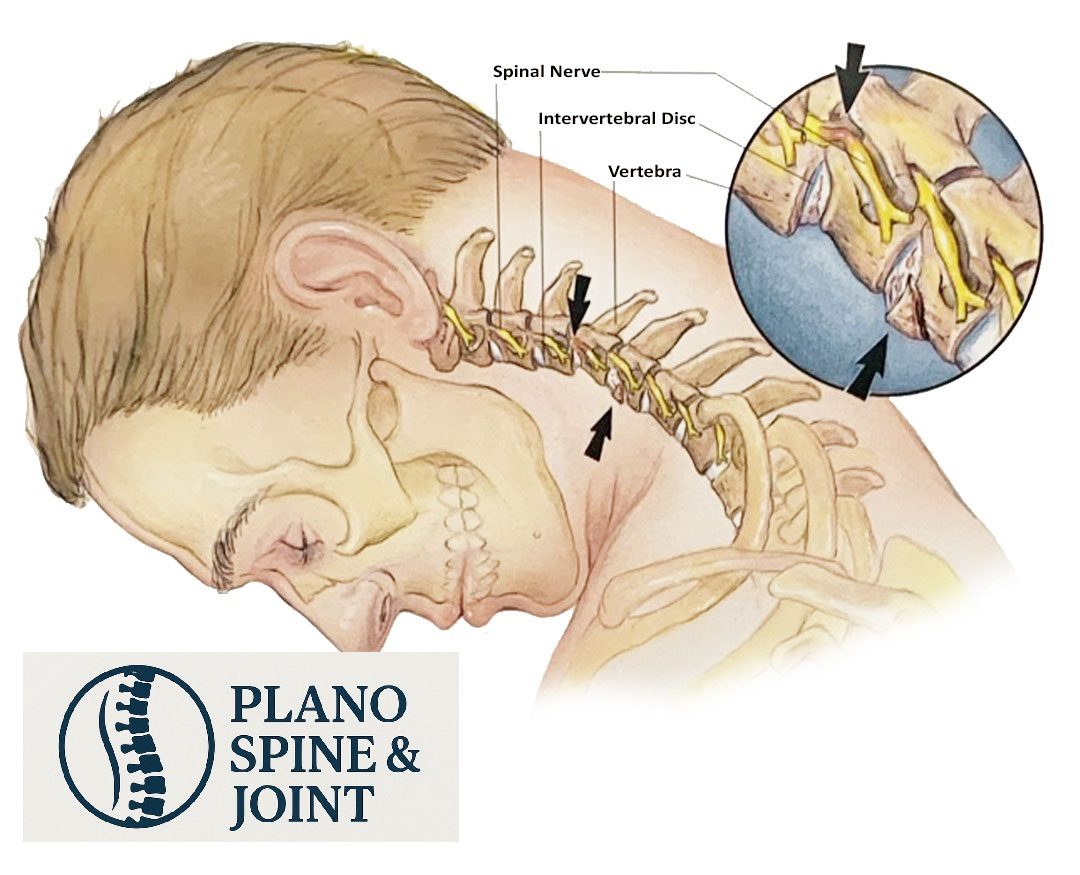
Whiplash is a soft tissue injury that occurs when the head is suddenly forced backward and then forward with significant acceleration and deceleration. This rapid movement places tremendous stress on the muscles, ligaments, tendons, and joints of the cervical spine.
Rear-end collisions are the most common cause of whiplash, although the injury can occur in side-impact crashes, head-on collisions, sports injuries, and falls.
Despite being one of the most common accident injuries, whiplash should never be dismissed as a minor condition. Damage to the supporting structures of the neck can lead to chronic pain, decreased mobility, headaches, muscle spasms, and long-term instability if left untreated.
What Is a Herniated Disc?
Between each vertebra in the spine is a disc that acts as a cushion and shock absorber. These discs have a tough outer layer surrounding a softer gel-like center.
During a motor vehicle collision, the tremendous force transmitted through the spine can cause a disc to bulge, tear, or herniate. When this occurs, disc material may place pressure on nearby spinal nerves or the spinal cord itself, leading to symptoms that extend beyond the neck.
Unlike whiplash, which primarily involves soft tissue injury, a herniated disc involves structural damage to one of the spine's intervertebral discs. In some patients, both injuries occur simultaneously.
How Do These Injuries Occur?
The mechanics of a car accident can create enormous forces throughout the spine in a fraction of a second.
As the vehicle is struck, the body is pushed forward while the head momentarily lags behind due to inertia. The neck then rapidly snaps backward before being thrown forward again. This motion stretches muscles and ligaments far beyond their normal range, producing the classic mechanism of whiplash.
At the same time, the compressive and rotational forces acting on the spine can increase pressure inside the spinal discs. If enough force is generated, the outer fibers of a disc may weaken or tear, allowing the inner material to protrude and irritate nearby nerves.
This is why it is common for accident victims to experience both soft tissue injuries and disc injuries following the same collision.
Symptoms of Whiplash
Whiplash symptoms often do not develop immediately. Because adrenaline can temporarily mask pain, many patients feel relatively well immediately after the accident before symptoms gradually worsen over the next 24 to 72 hours.
Common symptoms include:
- Neck pain and stiffness
- Reduced range of motion
- Muscle tightness
- Headaches beginning at the base of the skull
- Shoulder pain
- Upper back discomfort
- Muscle spasms
- Tenderness throughout the neck
Many patients also report difficulty sleeping due to discomfort and increased pain after remaining in one position for extended periods.
Symptoms of a Herniated Disc
A herniated disc may produce some of the same symptoms as whiplash, but nerve involvement often creates additional warning signs.
These may include:
- Pain radiating into the shoulder or arm
- Numbness or tingling in the hands or fingers
- Burning sensations
- Muscle weakness
- Loss of grip strength
- Pain that increases with coughing or sneezing
- Difficulty lifting the arm
- Changes in reflexes
These symptoms may indicate that a spinal nerve is being compressed and should be evaluated promptly.
Can You Have Both Injuries at the Same Time?
Absolutely.
One of the biggest misconceptions after a car accident is believing that only one injury is present. In reality, the same collision can injure muscles, ligaments, joints, discs, nerves, and surrounding soft tissues simultaneously.
Many patients initially believe they have "just whiplash," only to discover persistent numbness, arm pain, or weakness several weeks later. Further evaluation may reveal an underlying cervical disc injury that was not immediately apparent.
This is one reason comprehensive examinations are so important after any motor vehicle accident
How Accident Doctors Tell the Difference
Because symptoms frequently overlap, determining whether a patient has whiplash, a herniated disc, or both requires a thorough evaluation rather than relying on symptoms alone.
At Plano Spine & Joint, Dr. Jason L. Ardis performs a detailed examination that may include orthopedic testing, neurological assessments, muscle strength testing, range-of-motion measurements, sensory evaluations, reflex testing, and functional movement analysis.
The goal is not simply to identify where pain is located but to determine why the pain exists and whether nerve involvement or spinal instability is present.
When Is an MRI Necessary?
Standard X-rays are excellent for identifying fractures and evaluating spinal alignment, but they cannot directly visualize muscles, ligaments, tendons, or spinal discs.
If examination findings suggest a significant disc injury, persistent neurological symptoms, or a lack of improvement with conservative care, advanced imaging such as an MRI may be recommended.
MRI studies allow healthcare providers to evaluate:
- Herniated discs
- Disc bulges
- Ligament injuries
- Spinal cord compression
- Nerve root irritation
- Soft tissue damage
Not every patient requires an MRI immediately after an accident, but knowing when advanced imaging is appropriate is an important part of comprehensive accident care.
Why Early Treatment Matters
Many accident victims assume neck pain will simply resolve on its own. While some mild injuries improve with time, others can progress into chronic conditions if left untreated.
Inflammation may increase over the days following the collision, scar tissue can develop within injured muscles and ligaments, and abnormal movement patterns may become established as the body compensates for pain.
Early evaluation allows healthcare providers to identify injuries before they become more difficult to treat and helps establish accurate documentation of accident-related symptoms.
Comprehensive Auto Accident Care at Plano Spine & Joint
Dr. Jason L. Ardis, D.C. and the experienced team at Plano Spine & Joint specialize in diagnosing and treating injuries resulting from motor vehicle accidents.
Every patient receives an individualized treatment plan based on their examination findings, symptoms, and recovery goals. Treatment may include advanced chiropractic care, soft tissue rehabilitation, therapeutic exercise, neuromuscular re-education, spinal stabilization techniques, and coordination of MRI imaging and specialist referrals when clinically indicated.
By addressing both the underlying injury and the patient's functional limitations, Plano Spine & Joint focuses on helping patients recover safely while reducing the risk of long-term complications.
FAQ Section
How can I tell if I have whiplash or a herniated disc?
Both injuries can cause neck pain and stiffness, but a herniated disc is more likely to produce symptoms such as numbness, tingling, weakness, or pain that radiates into the shoulder or arm. A comprehensive examination is needed to determine the exact cause.
Can a car accident cause both whiplash and a herniated disc?
Yes. The same collision can injure muscles, ligaments, joints, and spinal discs at the same time. It is common for patients to have both conditions simultaneously.
Do whiplash symptoms appear immediately?
Not always. Many patients experience delayed symptoms that develop over the first 24 to 72 hours after an accident because adrenaline initially masks pain.
When should I get an MRI after a car accident?
An MRI may be recommended if you have persistent pain, numbness, tingling, muscle weakness, suspected nerve compression, or symptoms that are not improving with conservative treatment.
Can whiplash heal without treatment?
Some mild cases improve with time, but untreated whiplash can lead to chronic pain, reduced mobility, headaches, and scar tissue formation. Early evaluation helps determine the severity of the injury.
Can a herniated disc heal without surgery?
Many herniated discs can be managed with conservative treatment, including rehabilitation, chiropractic care, therapeutic exercise, and activity modification. Surgery is not necessary for every patient.
Why should I see an accident doctor instead of waiting?
Accident doctors are experienced in identifying injuries that may not be immediately obvious, including hidden soft tissue damage, disc injuries, and neurological problems. Early diagnosis often leads to better outcomes.
Does Plano Spine & Joint provide MRI referrals?
Yes. When clinically indicated, Dr. Jason L. Ardis coordinates MRI imaging and referrals to appropriate specialists to ensure patients receive comprehensive diagnostic evaluation and treatment.