
What Imaging is Best for an Auto Accident and Why?
After a car accident, one of the most important parts of the recovery process is determining the extent of the injuries. Many accident victims experience neck pain, back pain, headaches, stiffness, numbness, or joint pain, but are unsure what type of imaging they actually need.
Should you get an X ray?
Do you need an MRI?
When is a CT scan necessary?
The truth is that there is no single imaging test that is best for every auto accident injury. Different imaging studies serve different purposes, and choosing the right one depends on the patient’s symptoms, physical examination findings, mechanism of injury, and response to treatment.
At Plano Spine & Joint, Dr. Ardis, D.C. evaluates accident injuries carefully to determine when imaging may be necessary and which type of imaging may provide the most useful information. Proper imaging not only helps guide treatment decisions, but it can also play an important role in documenting injuries for insurance and legal purposes.
Why Imaging Matters After a Car Accident
The body absorbs significant force during a collision, even in car accidents that appear minor. Sudden acceleration, deceleration, twisting, or side impact forces can affect the spine, joints, muscles, ligaments, and discs.
Some injuries are immediately obvious, while others develop slowly over time. Imaging helps providers determine:
- Whether structural damage is present
- Whether there is spinal instability
- If nerves or discs are involved
- Whether fractures exist
- If inflammation or degeneration may be contributing to symptoms
Imaging also helps differentiate between soft tissue sprain and strain injuries versus more serious structural injuries that may require advanced treatment or referral.
Choosing the correct imaging at the right stage of care is critical.
X Rays After an Auto Accident
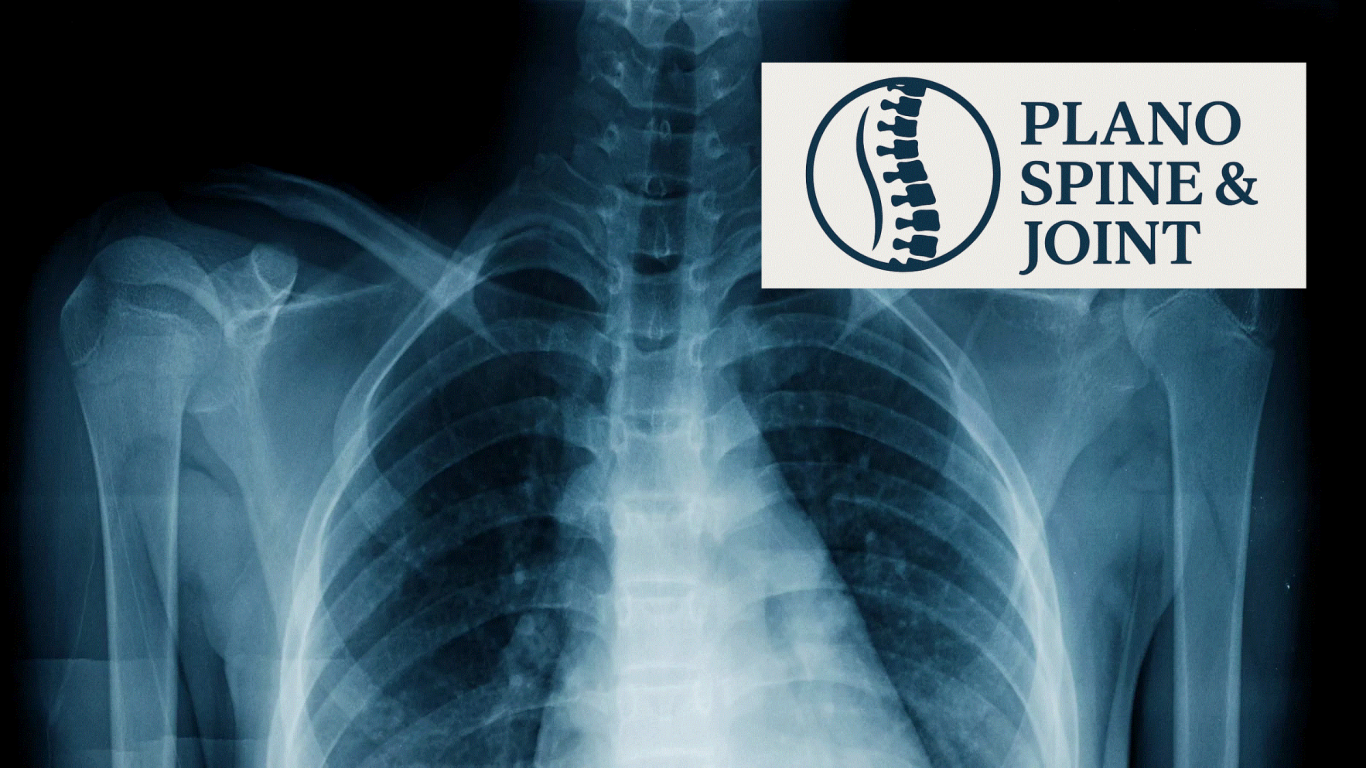
X-rays are often one of the first imaging tools used after a car accident. They are fast, widely available, and useful for evaluating bones and overall spinal alignment.
What X-Rays Are Best For
X-rays are commonly used to evaluate:
- Fractures
- Dislocations
- Alignment abnormalities
- Loss of spinal curvature
- Degenerative changes
- Instability concerns
For example, a patient with neck pain after a rear end collision may receive cervical spine X-rays to evaluate spinal alignment and rule out obvious fracture or dislocation.
At Plano Spine & Joint, X-rays can also help evaluate biomechanical changes in the spine that may occur after trauma.
Limitations of X-Rays
Although X-rays are important, they do have limitations. They primarily show bone structures and do not clearly visualize soft tissues such as:
- Discs
- Ligaments
- Nerves
- Muscles
- Tendons
This means a patient may have severe pain or neurological symptoms even when X-rays appear “normal.”
For this reason, additional imaging may sometimes be necessary if symptoms persist or if structural soft tissue injury is suspected.
MRI After a Car Accident
An MRI, or magnetic resonance imaging study, is often considered one of the most valuable imaging tools for evaluating soft tissue injuries after an auto accident.
Unlike X rays, MRIs provide detailed images of:
- Intervertebral discs
- Spinal nerves
- Ligaments
- Muscles
- Soft tissue structures
- Inflammation
- Disc herniations and bulges
MRI imaging is especially important when patients continue experiencing symptoms after conservative care or when neurological symptoms are present.
When an MRI May Be Recommended
At Plano Spine & Joint, MRI referrals are often considered after a patient has undergone a period of conservative care and symptoms are not improving as expected.
This is important because many sprain and strain injuries improve with treatment over time. However, when symptoms persist, it raises concern that deeper structural damage may exist.
An MRI may be appropriate when patients experience:
- Persistent neck pain
- Chronic back pain
- Radiating arm or leg pain
- Numbness or tingling
- Weakness
- Severe headaches with neck pain
- Suspected disc injury
- Suspected nerve compression
MRI imaging helps determine whether symptoms are related to soft tissue sprain and strain alone or whether structural damage such as a herniated disc is present.
Why MRI Timing Matters
One of the most misunderstood aspects of accident care is MRI timing.
Many patients believe they should receive an MRI immediately after a collision. While emergency situations sometimes require immediate advanced imaging, many accident cases begin with conservative treatment first.
There are several reasons for this:
- Many soft tissue injuries improve naturally with care
- Conservative treatment helps establish medical necessity
- Insurance companies often deny early MRI requests
- Clinical progression helps determine whether structural injury is likely present
In many cases, MRI referrals are commonly considered around the end of approximately one month of conservative care if symptoms are not improving.
This timeframe helps providers determine whether sprain and strain injuries have failed to improve and whether structural damage may exist.
CT Scans After an Auto Accident
CT scans, or computed tomography scans, are another important imaging tool used after car accidents.
A CT scan provides detailed cross sectional images of bones and internal structures and is commonly used in emergency or hospital settings.
CT Scans Are Often Best For:
- Suspected fractures
- Severe trauma
- Head injuries
- Internal bleeding concerns
- Skull fractures
- Complex spinal injuries
CT scans are especially useful in high impact accidents where there is concern for serious injury.
In emergency situations, CT scans are often preferred over MRI initially because they are faster and highly effective for identifying fractures and acute trauma.
What Imaging is Best Overall After a Car Accident?
The best imaging depends on the injury and stage of care.
X Rays
Best for:
- Bones
- Alignment
- Fractures
- Initial evaluation
MRI
Best for:
- Disc injuries
- Nerve compression
- Ligament damage
- Persistent symptoms
- Soft tissue injuries
CT Scan
Best for:
- Major trauma
- Fractures
- Emergency injuries
- Internal damage
No single imaging study is universally “best.” Instead, the right imaging is determined by the patient’s symptoms, clinical findings, and response to treatment.
At Plano Spine & Joint, Dr. Ardis, D.C. carefully evaluates each patient individually to determine whether imaging is necessary before or during your accident treatment and which type of imaging may provide the most clinically useful information.
Why Proper Imaging Documentation Matters for Insurance Claims
Imaging can play a major role in auto accident cases because insurance companies often look for objective evidence of injury.
For example:
- A disc herniation on MRI
- Loss of cervical curve on X ray
- A fracture identified on CT scan
can help support the severity of an injury.
However, imaging alone is not enough. Proper medical documentation is equally important.
Insurance carriers often scrutinize:
- Timing of imaging
- Medical necessity
- Treatment history
- Symptom progression
- Physical examination findings
This is one reason conservative care and consistent documentation are so important after an accident.
At Plano Spine & Joint, treatment records, examination findings, imaging referrals, and symptom progression are carefully documented to help establish a clear medical timeline.
The Goal of Imaging After an Auto Accident
The purpose of imaging is not simply to “take pictures.” The real goal is to:
- Identify injuries accurately
- Guide treatment decisions
- Determine severity
- Rule out dangerous conditions
- Monitor healing progress
- Support medical necessity
- Protect the patient medically and legally
Accident injuries can become chronic if not properly diagnosed early. Imaging helps providers determine the best path forward for recovery.
How Plano Spine & Joint Helps Auto Accident Patients
At Plano Spine & Joint, Dr. Ardis, D.C. provides comprehensive evaluations for patients involved in motor vehicle accidents throughout Plano and surrounding communities.
The process may include:
- Detailed injury evaluation
- Orthopedic and neurological testing
- Range of motion analysis
- Conservative treatment planning
- Progress monitoring
- Imaging referrals when appropriate
The goal is to identify injuries early, provide appropriate conservative care, and determine whether advanced imaging is necessary based on the patient’s condition and recovery progress.
Final Thoughts
After an auto accident, choosing the right imaging is an important part of identifying injuries and protecting your long term health.
X rays, MRIs, and CT scans all serve different purposes, and the best imaging depends on the specific injury pattern and symptoms involved.
While some patients improve with conservative care alone, others may require advanced imaging to identify structural damage such as disc injuries, nerve compression, or fractures.
If you have been injured in a car accident, Dr. Ardis, D.C. at Plano Spine & Joint can evaluate your condition, monitor your recovery, and determine whether imaging may be necessary as part of your treatment plan.
FAQ Section
What imaging is usually done first after a car accident?
X rays are often performed first because they help evaluate bones, fractures, alignment, and spinal stability.
What is the best imaging for soft tissue injuries after an accident?
MRI is generally considered the best imaging for evaluating soft tissue injuries such as disc damage, ligament injuries, and nerve compression.
Why would I need an MRI after a car accident?
An MRI may be needed if symptoms persist, neurological symptoms develop, or structural injuries such as herniated discs are suspected.
What is the difference between an MRI and a CT scan?
MRI is best for soft tissues such as discs and nerves, while CT scans are best for fractures, severe trauma, and emergency evaluation.
Can insurance deny MRI imaging after a car accident?
Yes. Insurance companies may deny MRI requests if they believe the imaging was ordered too early or without enough medical necessity documentation.
Why do doctors sometimes wait before ordering an MRI?
A period of conservative care helps determine whether symptoms are improving as expected from sprain and strain injuries or whether deeper structural damage may be present.
What symptoms may suggest I need advanced imaging?
Persistent pain, numbness, tingling, weakness, radiating pain, headaches, or symptoms that do not improve with treatment may support the need for advanced imaging.
Can Dr. Ardis, D.C. refer patients for imaging?
Yes. At Plano Spine & Joint, imaging referrals may be made when clinical findings and treatment progression support medical necessity.