
Back Pain After a Car Accident: What Type of Injury Could You Have?
Back pain is one of the most common complaints people experience following a motor vehicle collision. Sometimes the pain begins immediately. Other times, a person walks away from the accident feeling relatively normal only to develop stiffness, soreness or significant back pain later that day or over the next several days.
But back pain after a car accident is a symptom, not a diagnosis.
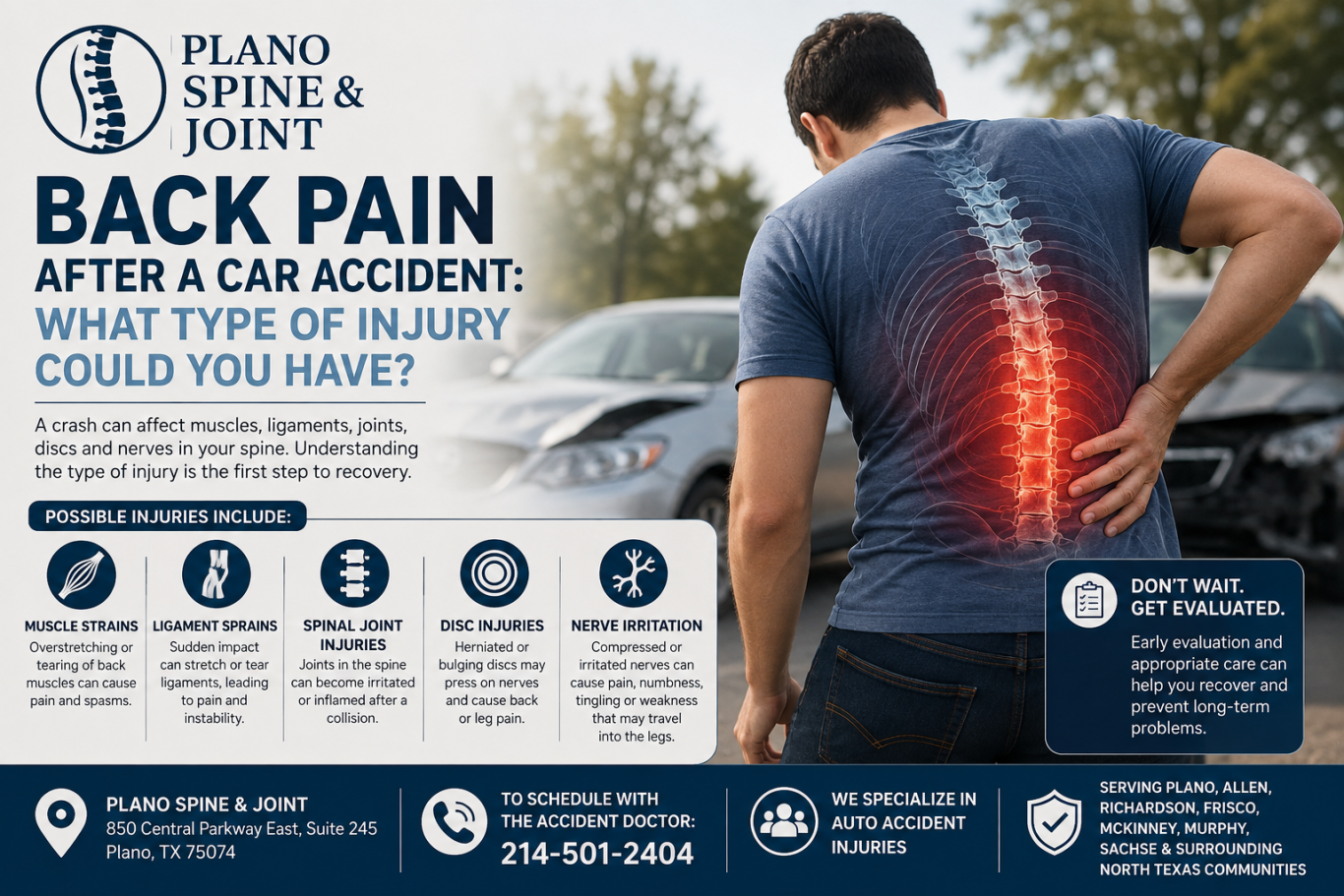
The sudden forces created during a collision can affect muscles, ligaments, spinal joints, intervertebral discs and nerves. Two people involved in similar accidents can therefore develop very different injuries and require very different approaches to treatment.
At Plano Spine & Joint, Dr. Jason Ardis, D.C. evaluates car accident injuries to determine what structures may have been affected and whether additional diagnostic evaluation is appropriate. For patients experiencing back pain after a car accident in Plano, identifying the likely source of the pain is an important first step toward developing an appropriate rehabilitation plan.
Why Does Your Back Hurt After a Car Accident?
Your spine is designed to move, support your body and tolerate the forces associated with normal daily activity. A motor vehicle collision is different.
During an impact, the torso may suddenly accelerate, decelerate, twist or move sideways while restrained by the seat belt. This can place unusual stress on the muscles, ligaments, joints and discs of the spine.
The location and severity of a car accident back injury can depend on many factors, including the direction of impact, position of the occupant and forces involved in the collision.
Rear-end collisions, side impacts and head-on crashes can each affect the body differently.
That is why determining the cause of post-accident back pain requires more than simply identifying where it hurts.
Muscle Strains After a Car Accident
One possible source of back pain is injury to the muscles supporting the spine.
During a collision, muscles may rapidly contract in response to the impact or be stretched beyond their normal range. This can result in pain, tenderness, tightness and muscle spasms.
A person with a muscular injury may notice that the back feels especially stiff after sitting for an extended period, getting out of bed or attempting certain movements.
Muscle injuries can be painful, but they are only one possible explanation for post-accident back pain.
Ligament Sprains and Soft Tissue Injuries
Ligaments help stabilize the joints of the spine by connecting one bone to another.
Sudden twisting, bending or stretching during a collision can injure these tissues. These injuries are commonly described as sprains.
Together, sprains and strains after a car accident can produce symptoms such as soreness, stiffness, tenderness, muscle guarding and reduced range of motion.
One important consideration is that many soft-tissue injuries are not directly visible on a standard X-ray.
This is one reason a physical examination remains important even when initial imaging does not reveal a fracture.
Spinal Joint Injuries
The individual vertebrae of the spine connect through small joints that allow controlled movement.
During an automobile collision, sudden compression, rotation or extension can stress these joints. When a spinal joint becomes irritated or injured, patients may experience localized pain, stiffness or discomfort with particular movements.
For example, turning, bending, standing after prolonged sitting or extending the back may reproduce symptoms.
Because muscle, ligament and joint injuries can produce overlapping symptoms, examination findings help determine which structures may be involved.
Herniated or Bulging Disc After a Car Accident
Between the vertebrae are intervertebral discs that help distribute forces throughout the spine.
A collision can expose these discs to compression, twisting and other forces. In some cases, trauma may contribute to a bulging or herniated disc or aggravate a pre-existing disc condition.
A disc injury does not always cause the same symptoms.
Some patients experience primarily localized back pain. Others develop symptoms associated with irritation or compression of a nearby spinal nerve.
Those symptoms may include:
- Pain traveling into the buttock or leg
- Numbness or tingling
- Burning sensations
- Leg weakness
- Electric or shooting pain
- Increased pain with certain movements or positions
Symptoms extending from the lower back into the leg are particularly important to evaluate because they may indicate neurological involvement rather than an isolated muscle strain.
Sciatica and Nerve Irritation After a Car Accident
When a lumbar spinal nerve becomes irritated or compressed, pain and other symptoms can travel away from the spine.
Patients often use the term sciatica after a car accident to describe pain extending from the lower back or buttock into the leg.
Nerve-related symptoms may also include numbness, tingling, burning sensations or weakness.
This distinction matters because treating ordinary muscle soreness is different from evaluating symptoms that suggest possible nerve involvement.
Persistent or progressive neurological symptoms may also influence whether additional testing, imaging or medical referral is appropriate.
Could a Car Accident Aggravate an Existing Back Problem?
Yes.
Not every abnormality discovered after an accident necessarily began on the day of the collision.
Many adults have pre-existing degenerative changes, disc abnormalities or previous episodes of back pain. Some of these conditions may have produced few or no symptoms before the accident.
Trauma can sometimes aggravate a pre-existing condition and produce new or increased symptoms.
For this reason, Dr. Jason Ardis, D.C. considers the patient's previous medical history along with the circumstances of the collision, current symptoms and physical examination findings.
The goal is to understand what changed following the accident rather than assuming every abnormal finding is either entirely new or completely unrelated.
Why Can Back Pain Be Delayed After a Car Accident?
It is possible to feel relatively well immediately after a collision and develop significant discomfort later.
The body's stress response surrounding an accident can temporarily influence pain perception. Muscle guarding, inflammation and soft-tissue irritation may also become increasingly noticeable during the hours following the collision.
Delayed symptoms can include back stiffness, muscle soreness, difficulty bending, pain when sitting or driving and discomfort that becomes more noticeable the following morning.
This is why delayed back pain after a car accident should not automatically be dismissed simply because you did not experience severe pain at the scene.
How Is a Car Accident Back Injury Evaluated?
The purpose of an accident-focused examination is to determine which structures may have been injured and whether there are findings that require additional investigation.
At Plano Spine & Joint, an evaluation may include:
- A detailed history of the collision and symptoms
- Spinal range-of-motion testing
- Orthopedic examination
- Neurological testing
- Muscle strength testing
- Evaluation of painful joints and soft tissues
- Assessment of radiating pain, numbness or tingling
- X-rays or referral for additional imaging when clinically appropriate
The examination also helps determine whether the condition is appropriate for conservative rehabilitation or whether another medical provider should become involved.
Do You Need an X-Ray or MRI for Back Pain After a Car Accident?
Not every patient experiencing back pain after an accident requires advanced imaging.
X-rays are useful for evaluating bones, alignment and certain structural abnormalities, but they do not provide the same information about spinal discs and other soft tissues that an MRI can provide.
An MRI after a car accident may become appropriate when symptoms or examination findings suggest disc or nerve involvement, neurological symptoms are present, or a patient's condition does not improve as expected with conservative care.
Imaging should be based on clinical need rather than automatically ordered for every accident patient.
Plano Spine & Joint evaluates the patient's symptoms, examination findings and progress to help determine when additional imaging or referral may be appropriate.
When Back Pain After a Car Accident Requires Immediate Medical Attention
Most post-accident back pain does not represent a medical emergency. However, certain symptoms require prompt or emergency medical evaluation.
Seek urgent medical attention for symptoms such as:
- Significant or rapidly worsening weakness
- Loss of bladder or bowel control
- Numbness involving the groin or saddle area
- Severe pain following significant trauma
- Difficulty walking or maintaining balance
- Symptoms suggesting a fracture or other serious injury
Severe abdominal or chest symptoms, loss of consciousness or other emergency symptoms following a collision also require appropriate emergency evaluation.
When serious injury is suspected, chiropractic or rehabilitation treatment should not replace emergency medical care.
Car Accident Back Injury Treatment and Rehabilitation
Once the likely source of back pain has been identified, treatment can be tailored to the patient's individual findings.
Depending on the injury, car accident rehabilitation may involve chiropractic care, therapeutic exercises, mobility work and other supportive therapies designed to improve function during recovery.
Treatment may focus on restoring movement, reducing muscle guarding, improving strength and helping the patient gradually return to normal activities.
The important point is that there should not be a one-size-fits-all treatment plan for every person experiencing back pain after an accident.
A patient with a muscle strain may require a different approach than someone experiencing symptoms associated with a disc injury or nerve irritation.
Back Pain After a Car Accident in Plano, Texas
Plano drivers spend considerable time traveling busy North Texas roadways such as US 75 Central Expressway, President George Bush Turnpike, Dallas North Tollway, Preston Road, Parker Road, Coit Road and Spring Creek Parkway.
Rear-end crashes in congested traffic, intersection collisions and higher-speed highway accidents can expose the spine to very different forces.
Regardless of where the accident happened or how much vehicle damage occurred, persistent back pain deserves appropriate attention.
The important question is not simply:
“Does my back hurt?”
It is:
“What was injured, and what is the appropriate next step?”
Back Pain Evaluation at Plano Spine & Joint
If you're experiencing back pain after a car accident in Plano, Dr. Jason Ardis, D.C. and Plano Spine & Joint can evaluate your symptoms and determine whether your pain appears to involve muscles, ligaments, spinal joints, discs, nerves or a combination of structures.
When additional imaging or medical evaluation is appropriate, referrals can be made based on the patient's individual findings.
The goal is to understand the injury first and then develop an appropriate rehabilitation strategy.
Schedule a Car Accident Back Injury Evaluation
Plano Spine & Joint
850 Central Parkway East, Suite 245
Plano, TX 75074
📞 To Schedule With The Accident Doctor: Call 214-501-2404
Plano Spine & Joint serves accident injury patients throughout Plano, Allen, Richardson, Frisco, McKinney, Murphy, Sachse and surrounding North Texas communities.
This article is intended for educational purposes and is not a substitute for individualized medical advice. Every accident and injury is different. Emergency or potentially serious symptoms require appropriate emergency medical evaluation.
Frequently Asked Questions
What is the most common cause of back pain after a car accident?
There is no single cause. Back pain following a collision may involve muscle strains, ligament sprains, spinal joint irritation, disc injuries or nerve involvement. An examination can help determine which structures may be contributing to the symptoms.
Can a car accident cause a herniated disc?
Trauma from a motor vehicle collision can place substantial forces on the spine and may contribute to disc injury or aggravate a pre-existing disc condition. Disc-related symptoms can include localized pain or radiating pain, numbness, tingling or weakness.
Why did my back start hurting a few days after my car accident?
Post-accident symptoms are not always immediate. The body's stress response can initially influence pain perception, while inflammation, muscle guarding and soft-tissue irritation may become more noticeable during the hours or days following a collision.
Does lower back pain after a car accident mean I have a disc injury?
No. Lower back pain can originate from muscles, ligaments, spinal joints, discs and other structures. Radiating pain, numbness, tingling or weakness may raise greater concern for nerve or disc involvement, but diagnosis requires appropriate evaluation.
Do I need an MRI for back pain after a car accident?
Not everyone needs an MRI. The decision depends on symptoms, examination findings, neurological findings and clinical progress. MRI may be considered when disc or nerve involvement is suspected or when symptoms do not improve as expected.
Where can I get evaluated for back pain after a car accident in Plano?
Plano Spine & Joint at 850 Central Parkway East, Suite 245 in Plano provides accident-focused musculoskeletal evaluation and rehabilitation under the direction of Dr. Jason Ardis, D.C.